"Every planet has its own weird customs. About a year before we met, I spent six weeks on a moon where the principal form of recreation was juggling geese. My hand to God. Baby geese - goslings! They were juggled."
Showing posts with label Pucará. Show all posts

Wednesday, October 24, 2012

Big long illustrated update


I realized as I write this that I am, in fact, almost halfway through my stay in my new site.  I guess it's not my 'new' site anymore, but my permanent site.

Five months has gone by fast, but I still went through the normal cultural adjustment stages.  When I arrived, everything was fantastic and new and nothing could be bad.  Then I sank into confusion about what to do.  Then I missed 'home,' home in the general term for the States.  Since then it's pretty much been up and down on a daily or hourly basis.  I still have some days where I prefer to just stay home and read or make something.  I'm grateful for the days when I have a mountain of laundry to wash by hand, or I have to spend some time forraging for plants for my rabbit.  Sometimes I walk the hour down the mountain to Apuela for internet even though someone in town offers his computer and internet for an hourly fee.  I just like to go. 

I've focused completely on trash management, at first only on accident.  I think it started when I made my recycled art projects on the benches outside one of the two stores in town.  The store owner started making her own folded chip bag wallet, then others picked up on it.  I did just a couple workshops at the afternoon kids' group and more adults began their own projects.  Once I began teaching recycled art in the school, many parents and their families got interested and started their projects.




I've also been helping out in the tree nursery, but so far progress has been pretty disappointing.  I can only convince the other workers to do something if there's a tourism group coming to visit.  We tried moving the workday from Friday to Monday and tried to assign a daily schedule to water the trees (only 15 minutes!) but nothing worked.  Now it's pretty much just me and another American volunteer who are watering the trees every day so they don't die.


The tree nursery is really interesting though.  First, it's a joy to see seeds germinate and near-dead twigs come blooming back to life with the copious water we bring.  And with that comes more wildlife.  One tree, a chinchin as it's known, is host to the larva of a big yellow butterfly.  Its larva are green and spiky and have a colorful purple, green or pink crysallis.  I used to take some home to watch:


I haven't travelled much at all since moving sites.  Technically there's a rule in Peace Corps that says if you move sites, you can't take vacation for three months.  Which was fine because I didn't have any money to climb mountains.  Pretty sad actually.  But I for sure didn't pass up the fantastic whale migration whose hub is Puerto Lopez.  It didn't disappoint this year and we even visited Isla de la Plata to glimpse blue-footed boobies (and red-footed boobies and Nazca boobies).  It was a nice break...


When I returned home, my family celebrated my birthday!  It was a wonderful surprise complete with cake brought in from 'outside'.  As you can see, it didn't completely survive the three-hour car ride:


Last month I began working on a recycling project.  There had been a program before my time but it didn't take.  My plan was to imitate another Peace Corps Volunteer's successful project in Santo Domingo by holding a recycling contest in the school.  My project ended up being a little different than hers as a couple months ago a group of volunteers literally filled my room with donations of toys, art supplies, and school supplies.  I was at a loss for what to do with the stuff and really didn't want to be the one to hand it all out like charity.  Using the stuff as prizes seeing to be the solution.  So a few community members and I finished the small recycling center on the corner of the football field by completely enclosing it with metal screen and finishing it with a nice door and lock.  This was partly because we didn't want anyone taking away the plastic bins, to keep dogs out, and to keep kids from taking materials out to reuse in the contest. 


I was really exited when my host mom Alicia began collecting bottles right away:


Then her pile grew:


And grew:


Not many kids brought in recyclables the first week of the contest, but once it was clear to them that the program was on, they bombarded me with bags filled with bottles.  This was the second week:


The third week, we had to organize the small recycling center.  I invited the kids to earn 10 points per family if they helped me crush all the bottles.  What a BAD bad idea.  Ten kids in a small space stomping on a couple thousand bottles.  I regreted my decision immediately, but a few actually worked and in a couple hours we had finished the work.  The next day I tied up the bags and weighed them out - 80 kilos of plastic and 6 kilos of metal plus a bit of cardboard.  That's roughly equivalent to $21.  80 kilos of plastic represent about 2,700 bottles of various sizes. 


Like I said earlier, I haven't had time or money to climb any big mountains.  I'm for sure aching for the exercise and the adventure though.  When a couple tourists came through and requested a guided hike, the guide invited me along to get to know the mountain above us where our town's water comes from.  I had a bad cold but I pushed through it anyway (mistake, as it then progressed to a nasty sinus infection).  The top is covered in forest and is inhabited by Andean bears.  We didn't see any of the shy creatures, but we saw plenty evidence of their existence.


There have been a number of festivals in the area, including one where all the communities in the area gather with colored torches corresponding to their community (mine was white) and walk down to the town of Apuela for a nighttime Catholic mass.  It was quite stunning but of course that was the time my camera battery decided to no longer hold a charge.


Roughly every Saturday, a few women, their kids and I get together to work on recycled art projects.  Most of them have worked on the folded chip bag wallets but they seem to prefer paper bead making.


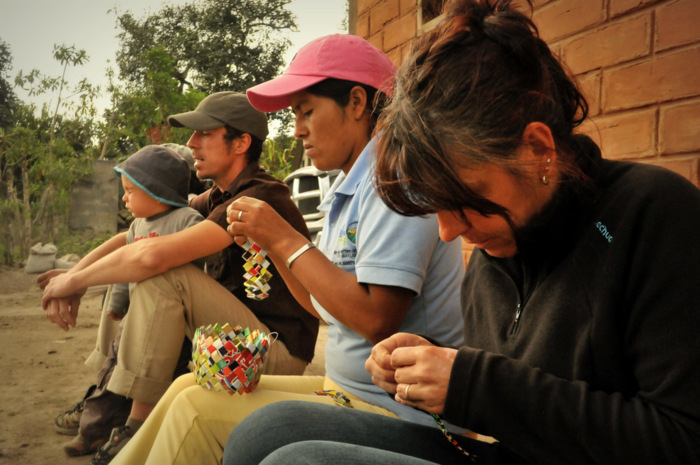

One of the women is a brilliant crocheter whose crafts are sold in the Intag store in Otavalo.  After I taught the schoolchildren to make plastic string for knitting, this artisan learned from her daughter and began making all kinds of amazing things.  One of her products was a traditional hat crocheted from black and transparent plastic string.  She likes the material so much that she now wants to buy new plastic bags...whoops...not really the point of reducing and recycling!  What's really ironic, though, is she's a cabuya artist.  She makes things out of a fiber produced from a big agave-like plant called the penca.  The fiber is called cabuya.  Before traffic arrived in Pucara and with it plastic products, these cabuya artisans wove bags to sell.  When plastic bags arrived, they pretty much snuffed this trade out of existence and now the artisans make their crafts to sell as purses and such for tourists.  Now these artisans know how to make string out of plastic and are crocheting that in plastic bags.  Funny...like an inversion.


About it for now...to be continued!

Thursday, June 21, 2012

The makers of panela: How to transform sugar cane into sugar

Yesterday another group from Siempre Verde passed through Pucara visiting a 'molienda,' or panela-making facility, and the community tree nursery.  When they left, the panela makers insisted I stay with them until the end - and it was just noon.  They began work at 3 a.m., helping themselves to doses of the Mexicano, a drink of trago (alcohol) with cane juice.  They figured they would be done by around 6 p.m.  The process is so incredible, so magical (am I being too cheesy?), that I did indeed stay to see all their 'paradas' through.  And I decided to show it all here and take you from live sugar cane stalks to juice to pure delicious sugar.

So the magic starts here:

Cutting the sugar cane for two whole days prior to the molienda
Next they pass each cleaned stalk through a gas-powered press, and the juice is caught and moves down a tube to a holding tank.

This is the cane juice extracted from the stalk and passed through a few filters where it begins warming in the tank below.


There are five tanks in this molienda.  The first tank (closest) holds one 'parada' (or batch) of sugar, the next two tanks hold the next parada, and the last two tanks hold the last parada, or the one most ready to be poured and set.

While the cane juice is cooking, it requires constant attention.  Sometimes the 'melero' (the person working the sugar) needs to use giant ladles made from dried gourds to pass the liquid from one of the two parada tanks to the other, then back again.

Soon foam forms on the surface of the paradas and the meleros here insist on skimming it off because it improves the taste of the sugar.  They also call it 'otavalillu' and say it's a delicacy, so when they skim off a wooden bowlful, they try to drink it instead of toss it out.

Except it is very, very sweet.  It has a unique flavor from cane juice and from panela, and it's only one of many different products they can create - not just sugar.

This guy is called the 'hornero,' or the guy who stokes the fire below the tanks.  One of the many beauties of this operation is that the squeezed and dried cane stalks are used to fuel the oven.

One of the meleros offers otavalillu to the Siempre Verde students.  The meleros are VERY proud of their work and they should be.  They love sharing every bit about the process with the community and visitors.

Next, a scoop of boiling-hot caramel-like sugar is poured into a wooden basin (called the caballo, or horse) and an artisan begins working a bit of it with a wood spatula.  At first he pushes the spatula around rapidly, then begins twirling the sugar until it turns from dark brown to light brown incorporating air bubbles.

Then in one fraction of a second, the sugar is twisted into a pillar right when it sets.  Sugar left on the spatula is pulled off, rolled to a ball, and stuck on top.

It's called 'santo,' or saint, because it ends up looking like a figurine.  And it is delicious, by far a favorite of everyone of any sugar product because of its light, airy texture.  It just melts in your mouth.

Now the parada in the last tank is released into a wood tank to cool and be worked over for maybe 10 or so minutes with a giant wooden paddle.  Kids love to dip spatulas in this and stick the boiling goo in water to cool, thus making caramel.

These are the sugar molds.  Other operations focus on making grain sugar, which is a slightly different process.  The molds must be slightly damp so the sugar doesn't stick to them (so this guy is wiping them down with a cloth) but they can't be wet or the sugar won't set properly.


The melero then scoops up a gourdful of panela and pours it expertly into the molds as the Siempre Verde kids look on.

It gets tougher as the sugar cools.

When the sugar sets (about 15 minutes, but longer to be on the safe side), they're popped out and joined together into panela hamburgers.  Each hamburger is worth $4.  In each parada, they produce maybe 15 hamburgers.  And in one day, they made a whopping six paradas.  I'll leave the math to you.

What kids wouldn't love to visit a sugar-making factory?

Tuesday, June 19, 2012

And we´re off...

Recycled art seems to have swept through Pucará faster than I ever would have imagined.  The first week I was in town, I showed my host family the crafts I´d made from trash (folded chip bags, crocheted plastic bags, paper, beads, etc.) and they told other people, and soon the teachers from the school saw the crafts, and soon everyone in the town wanted to know how to make them.

So now I´ll be in the school working with the older kids each Tuesday.  Today was our first day and I think they did well, except we ran into one problem - we ran out of trash!  I hope they continue to be excited about the idea and begin cleaning up the street and saving their own trash.  I worked with another community member´s group of kids last week and we did just that - collected a couple bags full of trash to wash and cut up.  Some teens came to this group and asked if we could have a workshop every day (every day!) to work on the trash projects.

Lately now I´m acting as the volunteer/Spanish school coordinator and kind of learning as I go.  The community has one student now who is only here for a few days, but the trick was finding activities for him to do in the afternoons.  Luckily another tourist group is coming through on Wednesday, so the family showing the group the panela-making process had to cut caña (sugar cane) today and yesterday for the demonstration.  The student helped them yesterday with cutting the caña and hopefully tomorrow will see how the caña juice is transformed into chemical-free granular sugar.

And finally... one of the teachers invited me to stay with her family in her house in Ibarra to see Inti Raymi (the indigenous festival of the solstice).  I missed it last year despite living in an indigenous community (they didn´t celebrate it).  Apparently the night before they dance all night in a circle and bathe in waterfalls.  Should be fun!

Siempre Verde high school group from Georgia and South Carolina (?) on a tour of a farm
Making panela (raw sugar) from caña (sugar cane) juice.  
Working in the vivero (tree nursery) during a minga.

Thursday, June 14, 2012

On being famous

¨Famous¨ may be the wrong word.  But after I agreed to act in a short comedy in front of the crowds of the festival of San Antonio de Pucará, there have been no shortage of comments from people I know and don´t know about how ¨I´m that girl in the play...¨ People joke and ask if I want to marry them too.  They call me the ´lungita.´ I guess you had to see it to understand...

The festival was last Saturday and included a soccer match (we lost), a voly tournament, various dances, and our little skit.  It was call the ´Divorcio de los indios´ which is in itself awkward because ´indio´ is often an offensive term...especially when used by someone who is not indigenous.  Like saying ´indian´ instead of ´native.´ But I played the role of María (I know, stunningly ironic) who, with her mother Francisca, is asking the local comesario (´cumisario´ is how I had to pronounce it) to divorce her abusive husband Manuel.  Pretty soon Manuel is flipping over the desk and the comesario is tossing a plastic chair aside, and María is hiding behind her mother.  The debate continues, when suddenly María changes her mind and Francisca demands Manuel be a better husband.  Kind of anticlimatic that in the end she takes him back.  But there were a lot of funny moments, and most of mine were when I forgot a line or completely mispronounced a word - like having to say ´Bunitu caballeritu.´ I totally stumbled on this word and pronounced it slowly into the microphone: ¨Boe-nee-too ca-bay-sher-ee-too,¨ and the crowd laughed so hard I could hear people in hysterics.

Oh yea, and I had to dress up as an indigenous woman.  I combined some of Chimborazo clothing with an Otavalo shirt... it looked confused, but fine in the end.

The community has meetings very frequently, for example, there´s a meeting today at 4 p.m. for the tourism council.  Quite a few tourism groups are coming through which the council organizes.

But before that I´m helping out a local woman with her group of kids - kind of like an extracurricular club.  The kids all saw what I´d made out of trash and wanted to make that their next project.  So hopefully today we´ll do some trash collection, wash it all off, and start making some pretty amazing things out of it all.  Apparently they´ll also be interviewing me for their program to be broadcast on Radio Intag.  Fun!

Finally, the school teachers were over for lunch one day and saw all my crafts too - and immediately began making their own chain links out of garbage I´d already cut up.  At the same time my host mom Alicia was continuing the cord on a bag I was knitting out of plastic bags.  It was quite a sight.  So the teachers decided they were going to collect their own trash this week and have me visit on Tuesday to help them teach the kids what to do. 

So I´m already busier in two weeks in Imbabura than I was in over a year in Chimborazo.  It´s exciting stuff. 

And so while I wait for pitifully slow internet to upload one of three videos I have ready, here are some pics!

Pucará
View to Plaza Gutierrez
View from the Pucará gazebo
Soccer game